
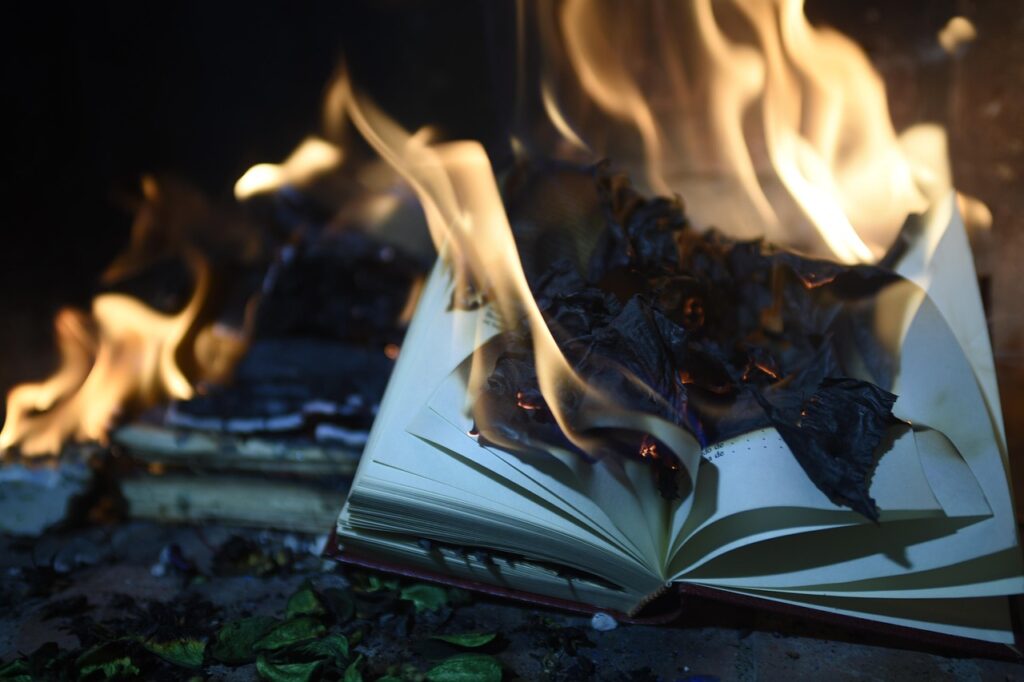
Terry Jones, pastor of the Dove World Outreach Center (Gainsville, FL), became an international news story in the weeks leading up to 9/11. Jones planned to mark the 9th anniversary of the attack by Muslim terrorists on the World Trade Center and other US targets by hosting a Qur’an burning. He was repeatedly implored by celebrities, religious leaders and politicians to cancel the planned inferno. Though he cancelled the event days before 9/11, protests among Muslims resulted in various parts of the world, sparking violence and loss of life.
Book burning is certainly not something new. One can see several occasions throughout history where books have been burned for one reason or another. Consider just a few examples:
- Chinese Emperor Qin Chi Huang ordered philosophy and history books from all states other than Qin be destroyed (213 BC). In the next generation, in a revolt against Qin’s son, most of the archives that remained were also burned.
- In 168 BC, Antiochus IV ordered that copies of the Jewish Law be torn and burned. This persecution is why the Dead Sea Scrolls were hidden.
- Josephus, a Jewish historian, tells of a Roman soldier who seized and publicly burned a copy of the Torah (50 AD). The offender was put to death by the procurator to avoid a revolt by the Jews againsts Rome.
- By decree of Diocletian, the Christian Scriptures were to be burned (303 AD). His intention was to completely exterminate Christianity.
- To avoid variance in the Qur’an, Uthman ordered all material, whether full copies or fragments, but his own to be collected and destroyed (656 AD).
- Louis IX, at the behest of Pope Gregory IX, had all copies of the Jewish Talmud in Paris collected and burned (1242 AD).
- Cuthbert Tunstal, bishop of London, had Tyndale’s English translation of the New Testament burned (1526 AD).
- Orthodox Jews burned several hundred copies of the New Testament in Jerusalem (March 1984).
- In several places, books of J.K. Rowling’s series, Harry Potter are burnt.
This is just a short list. In most cases, the burning of books is motivated by politics or religion. Often, the wrath which results in the burning does not stop at books. Qin chose to bury all dissenters alive. Burning the Torah was a minor part of Antiochus’ persecution of the Jews. In addition to burning the Scriptures, Diocletian also burned many Christians at the stake. Not only was Tyndale’s translation of the New Testament burned, but having been accused of heresy, he too was burned at the stake.
Heinrich Heine, a German playwrite, of the burning of the Qur’an during the Spanish Inquisition, said:
Where they burn books, so too will they in the end burn human beings. (Almansor, 1821)
What motive will compel one to burn something of value to another? What stirs in the heart of the one who craves to see what another loves be consumed and just ashes remain? What but hatred has kindled the flames used to destroy historical records, religious texts, and the like throughout the course of man’s dark history? What good has ever been accomplished, what progress has ever been achieved by fueling a fire that already burns hot and out of control?
I am not blind to the fact that believers suffer at the hands of Muslims in some countries, having their meeting places and homes engulfed in flames. Muslims are commanded in the Qur’an,
Fight those who do not believe in Allah … those who have been given the Book, until they pay the tax in acknowledgement of superiority and they are in a state of subjection. The Jews … and the Christians … imitate the sayings of those who disbelieved before; may Allah destroy them; how they are turned away. (Surah 9:29-30, Shakir)
I give no defense of Islam. The Muslim creed is one of violence, and believers the world over have suffered under the harsh hand of it’s adherants (Surah 9:73, 123, etc.). If fundamentalist Muslims burn church buildings, blow up market places, and fly jets into buildings, does that justify a response of equal anger from those professing to follow Jesus Christ?
Consider that the prophet Isaiah said of the Lord:
He was oppressed and He was afflicted, yet He opened not His mouth; He was led as a lamb to the slaughter, and as a sheep before its shearers is silent, so He opened not His mouth.(Isaiah 53:7)
The apostle Peter, after these things were accom-plished in Christ wrote:
For to this you were called, because Christ also suffered for us, leaving us an example, that you should follow His steps: ‘Who committed no sin, nor was deceit found in His mouth’; who, when He was reviled, did not revile in return; when He suffered, He did not threaten, but committed Himself to Him who judges righteously; who Himself bore our sins in His own body on the tree, that we, having died to sins, might live for righteousness – by whose stripes you were healed. (1 Peter 2:21-24)
The Lord has taught us how we are to respond to those who stand against us as an enemy. It is not with the sword, nor with a match or lighter. Hear the words of Christ:
But I say to you, love your enemies, bless those who curse you, do good to those who hate you, and pray for those who spitefully use you and persecute you… (Matthew 5:44)
The Qur’an calls for all religion to be for Allah (Surah 8:38), and the way to this end is the sword. The Bible says that salvation in Christ is for all (Titus 2:11), and the way to this end is the gospel message (Romans 1:16). Burning books and with those books, opportunities for discourse is contrary to the spirit and mission of Christianity. The love of Christ must be seen (Romans 12:14-21), not acts of anger spurred by the Devil himself.
Links: YouVersion | GROW magazine
Return to the article archive