

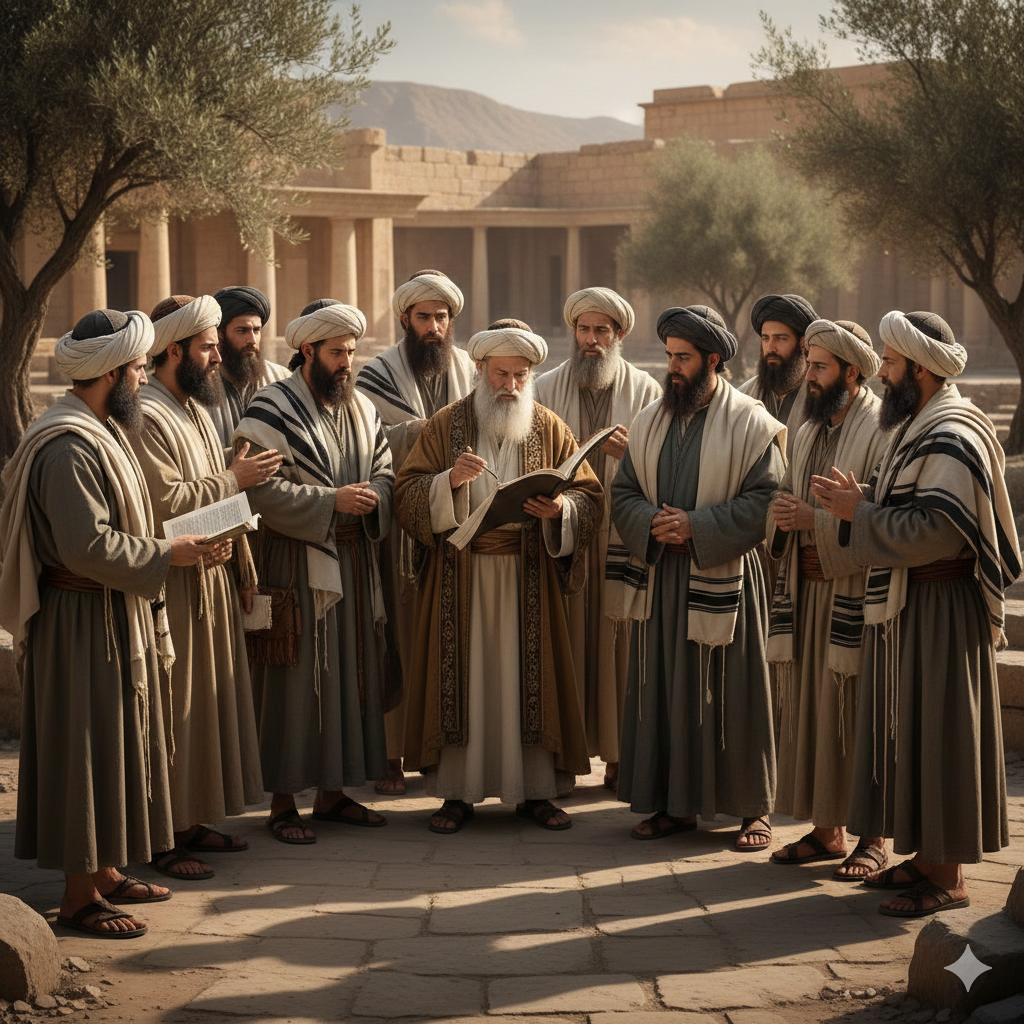
The apostle John, recording a discourse of Jesus before the people of Judea stated:
…even among the rulers many believed in Him, but because of the Pharisees they did not confess Him, lest they should be put out of the synagogue… (John 12:42)
The religious leaders of the Jews are often portrayed as a crowd of unbelievers, and rightly so, for that was the manner of most. And yet, John speaks of some who did believe in Jesus. As we look in the gospel accounts, we will see occasional references to these rulers who believed, most of whom did not openly display their faith in the Lord.
Nicodemus & Joseph
Nicodemus is found three times in the record of John’s gospel. The first time, he came to Jesus under the cloak of night. Presumably he sought to avoid discovery by his fellow rulers. He knew He was “..a teacher come from God..” (John 3:2), seeing the works which He did. Jesus spoke of salvation to him, saying that one must be born again (John 3:3, 5). He did not understand what Jesus said, despite the fact that he was a teacher in Israel.
The second time Nicodemus is mentioned by John, the Pharisees had sent officers to arrest Jesus, but came back without Him. The leaders accused them of being deceived. They also spoke of the crowds as being accursed people who did not know the law. And then, these same men inferred that none of the rulers believed in Jesus. It would have been easy for Nicodemus to stay silent, but he’d been silent for too long. Nicodemus said,
Does our law judge a man before it hears him and knows what he is doing? (John 7:51)
For his words, he was ridi-culed by the leaders of the Jews. Nicodemus, once a secret inquirer of Jesus’ had now become a public defender of His cause.
The third and final time Nicodemus is spoken of in the Scripture is in John 19. Jesus was put to death as the Pharisees desired. It is certain that Nicodemus did not clamour for His death as the rest did. He could not stop the wicked plot of his colleagues, but he was there to provide a dignified burial for the Lord. With Joseph of Arimathea, he received Jesus’ body from the Romans and buried him according to Jewish custom (John 19:38-42).
Like Nicodemus, Joseph had been a secret disciple of Jesus, for fear of the Jews. In a moment when one might expect that they would become more secretive about their faith in Christ, both men cast off their fears and made it known to all that they were followers of Jesus, who is called Christ.
Jairus
Luke & Mark speak of a ruler of the synagogue by the name of Jairus. He came to Jesus, pleading for his twelve year old girl’s life (Luke 8:41-42). The Lord went with him, but was delayed on the way by the woman who had the issue of blood. In the meantime, the little girl had passed away. It was said to Jairus by one who came to him, “why trouble the Teacher any further?” (Mark 5:35) But Jesus overheard this con-versation and said to him
Do not be afraid; only believe, and she will be made well. (Luke 8:50)
Coming into Jairus’ home, Jesus was ridiculed by the mourners because He said that she was asleep. After all were put out of the room, He simply said, “Little girl, arise,” and she did (Luke 8:54). The girl’s parents were astonished at the miracle performed (Luke 8:56; Mark 5:42).
The Rich Ruler
One simply identified as a ruler came to the Lord, asking how to inherit eternal life (Luke 18:18). He is called a young man in Matthew 19:22. Some-times the rulers would test Jesus, but that does not seem to be this young man’s intent. He wanted to know from the “Good Teacher” how to go to heaven. He had kept the law, but knew that he still lacked some-thing. Jesus revealed what it was – he was trying to serve both God and riches. Thus, Jesus told him to go sell all that he owned, give it to the poor, and he’d have eternal life. Though he had respect for Jesus as the “Good Teacher,” he failed to heed His word, walking away sorrowful (Luke 18:23).
Crispus & Sosthenes
During his time in Corinth, the apostle Paul went to the synagogue each week on the Sabbath (Acts 18:1, 4). Though he experienced opposition from the Jews, still many Jews and Greeks obeyed the gospel. Among them, a man by the name of Crispus, who was the ruler of the synagogue (Acts 18:8).
What do you do when the ruler of the synagogue becomes a Christian? First, the synagogue needed a new ruler to be appointed. Crispus was replaced by Sosthenes. Next, they rose up against Paul, who they no doubt blamed for the loss of their former ruler. They brought him before the proconsul, charging that he taught men to do contrary to God’s will (Acts 18:12-13). Before Paul could speak, Gallio revealed he had no pat-ience for the Jews and would not look into a matter of their law. Being put out from the judg-ment seat, the new ruler of the synagogue was taken by the Greeks and beaten (Acts 18:16-17).
How it happened, we are not told, but apparently it did. As Paul writes to the church at Corinth, his first epistle begins:
Paul, called to be an apostle of Jesus Christ through the will of God, and Sosthenes our brother, to the church of God which is at Corinth, to those who are sanctified in Christ Jesus, called to be saints… (1 Corinthians 1:1-2)
Did you see it? The new ruler of the synagogue followed in the footsteps of his predecessor. He was an opponent of the truth in Acts 18, but by the time that Paul wrote to the Corinthians, he was a faithful Christian.
What can be learned from all these men? Do not let the fear of men silence your faith. Don’t you think Joseph and Nicodemus wished that they’d been open about their faith earlier? Do not let riches keep you from serving the Lord. The young ruler made an awful mistake which would cost his soul. In Crispus and Sosthenes, we learn the need to be religiously right. Both left Judaism, choosing to obey God’s Son.
Not all of the rulers of the Jews were contrary to Jesus. Some believed and did nothing; others believed and obeyed. Imitate the good, learn from the bad.
Links: YouVersion | GROW magazine
Return to the article archive