

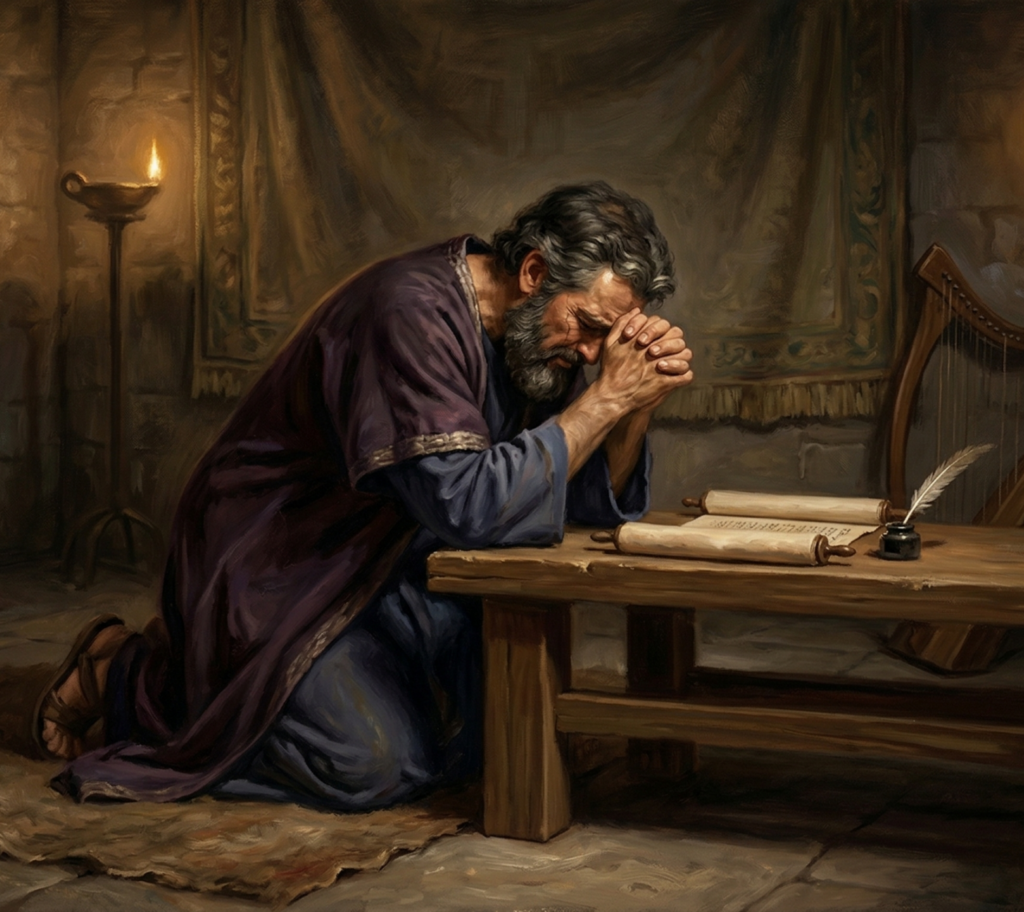
When David sat down to pen Psalm 51, he wasn’t writing a systematic theology on the origin of sin. He was a man crushed by the weight of his sin. What may have begun as a lazy season in a stalwart monarch’s life quickly deteriorated into a sin spiral. A lustful stare led to adultery with his neighbour’s wife. That moment of infidelity resulted in an impending birth. Fear of exposure drove David to deceive and intoxicate his friend Uriah, trying to cover his deed. When that failed, he sent Uriah back to the battlefield, carrying his own death sentence sealed by the king. In this Psalm, David wasn’t seeking an excuse or explanation; he was seeking a way back to God.
Yet for centuries, theologians have taken a single line from this gut-wrenching poem – verse 5 – and turned it into a cornerstone text for hereditary depravity. The verse reads:
Behold, I was brought forth in iniquity, and in sin my mother conceived me. (Psalm 51:5)
Lutheran theologian, Paul Kretzmann (1883-1965) explicitly ties David’s sin to inherited corruption:
…David, like all men, was sinful from the first moment of conception, flesh born of flesh, filled with all the corruption of mankind, all transgressions in thought, word, and deed being the result of the natural state of sinfulness, and the guilt of both laid upon every individual sinner. David thus made a full and unequivocal confession of the depth of his sin and of its full heinousness.1
Was David a sinner from conception? Did his transgression stem from inherent evil? To answer, we must read this verse in context – within the psalm, within Scripture, and within the nature of Hebrew poetry. When we do so, a very different picture emerges.
A Poetic Expression of Personal Guilt
Psalm 51 is a poetic lament. David is overwhelmed by “the guilt of bloodshed” (v 14) and feels the pain of the “bones which You have broken” (v 8). In deep despair, people often use universal language to express personal anguish.
A man who loses everything in a fire might say, “My whole life is nothing but ashes!” We don’t take him literally; we recognize the depth of his grief.
When David says he was “brought forth in iniquity” in Psalm 51, he is using hyperbole to magnify his failure. We see similar language in Psalm 58:3: “They go astray as soon as they are born, speaking lies.” If taken literally, infants would speak coherent, intentional lies from birth. Clearly, David is not describing a judicial guilt at birth, but the pervasive influence of sin.
A Confession, Not an Alibi
Matthew Henry (1662-1714) famously linked every “actual sin to the fountain of original depravity.”2 If that were accurate, then guilt is not grounded in what a person does, but in what they are by birth. In that case, David’s confession ceases to be a full assumption of personal responsibility, and culpability for sin is fundamentally undermined. David’s aim in Psalm 51 was not to assign blame to an ancestor, but to claim total ownership of his actions.
Notice the possessive language. He fixates on his own agency:
- “Blot out my transgressions” (v 1)
- “Wash me thoroughly from my iniquity” (v 2)
- “Cleanse me from my sin” (v 2)
- “For I acknowledge my transgression, and my sin is always before me” (v 3)
The climax comes in verse 4, “Against You, You only, have I sinned, and done this evil in Your sight.” David stands alone before God. He does not appeal to an inherited nature. He accepts the full weight of his guilt (not Adam’s) so that God may be “found just … and blameless…” in judgment (v 4).
Even after verse 5 David continues to own his guilt:
- “Hide Your face from my sins, and blot out all my iniquities” (v 9)
- “Deliver me from the guilt of bloodshed, O God” (v 14)
To anchor his sin to Adam would be to offer an alibi, not a confession. If sin were unavoidable by nature, his guilt would be mitigated. We don’t blame a lioness for killing prey – it acts according to nature. David was not a victim of inheritance – he was the architect of his own ruin.
What Does “Create in me” Really Mean?
When David pleads, “Create in me a clean heart” (v 10), many see proof of total depravity. It is argued that the Hebrew word for create, בּרא (baw-raw) “…is used of the creative operation of God, bringing into being what did not exist before…”3 Those who hold to the depravity paradigm suggest David was asking God to replace a fundamentally corrupt heart with a brand-new one. Matthew Poole (1624-1679) worded it this way:
“Create in me a clean heart; seeing I have not only defiled myself by these actual sins, but also have a most filthy heart, corrupted even from my birth, which nothing but God’s almighty and creating power can purify…”4
Adam Clarke (1762-1832) says, “Mending will not avail; my heart is altogether corrupted…”5 E.W. Bullinger (1837-1913) explains, “The new heart is not the old one changed, but newly created…”6
While בּרא often refers to God’s creative power, it does not strictly imply a “from-nothing” replacement. It can be used of a change in condition, and that by man’s hands as well. In Joshua 17, as the Israelites took possession of the land of Canaan, they were commanded to “clear” (בּרא) the land and “cut down” (בּרא) the woods (v 15, 18). They changed the landscape; they did not create a formerly non-existent space. This and other texts (1 Samuel 2:29; Ezekiel 21:19; 23:47) show the word בּרא is not limited to God creating, nor is it confined to things not already in existence.
In Psalm 51:10, בּרא refers to God’s work, yet it is not a replacement but a renewal. In the context, David asked for renewal (v 10) and restoration (v 12) of a heart defiled by personal transgression, not replacement of one rendered corrupt by Adamic sin.
David’s Life Tells a Different Story
If David were truly unregenerate prior to this petition, his entire life must be reconsidered. Was the man God called “after His own heart” (1 Samuel 16:7; Acts 13:22) a reprobate? Was David’s defeat of Goliath an act of a faithful follower (1 Samuel 17:37, 45-47) or of a spiritually bankrupt unbeliever? If Psalm 51 is evidence David was “altogether corrupted” at the time of his sin with Bathsheba, what are we to do with 1 Samuel 18, which states not once, not twice, but three times that “the LORD was with him” (v 12, 14, 28)?
The terminology in the Psalm contradicts the idea of inherent depravity. His requests reveal a man who already had a relationship with his Creator:
- “Do not cast me away from Your presence” (v 11a). Can God cast away from Him someone who was never in His presence?
- “Do not take Your Holy Spirit from me” (v 11b). How can God take what David did not already have? Does this request not prove he had access to God’s Spirit already?
- “Restore to me the joy of Your salvation…” (v 12). You cannot restore what was never there.
These are not the words of a man who never knew God. David was a moral, upright servant of God – even appointed by God as king. He fell from a height he already occupied. He was not asking for a new nature, but for restoration of a heart overcome by sin.
How Early Christians Read It
The idea that Psalm 51:5 demands total depravity is largely post-Augustinian (354-430 AD). Early Greek-speaking believers saw this as an expression of human frailty, not inherent guilt.
Athanasius (c. 296-373 AD) affirmed that man is created good and that sin is an intentional human choice rather than an innate property of our creation. In his work, Against the Heathen, he wrote:
“In the beginning wickedness did not exist. Nor indeed does it exist even now in those who are holy, nor does it in any way belong to their nature. But men later on began to contrive in and to elaborate it to their own hurt.”7
John Chrysostom (c. 347-407 AD) saw David describing the spreading of sin’s influence, not guilt at birth. In his commentary on the Psalms, he stated:
“Behold, I was born in guilt … as if saying to God: ‘Thus you wish to call me to account not only for my sins but also for those of my ancestors … they did not prove grateful to you, and neither did I – rather, I inherited in some fashion the ancestor’s ingratitude, and from them I draw the habit.”8
Clement of Alexandria (c. 150-215 AD) challenged the concept of inherited sin directly:
“Let them tell us then how the newly born child could be guilty of adultery, or how he who has as yet done nothing has fallen under the curse of Adam.” 9
These voices affirm that sin arises from influence, will, and habit – rebellion against God – not hereditary guilt.
What Did the Ancient Jews Believe?
Ancient Jewish sources also rejected innate depravity. Second temple writings (200 BC – 70 AD) such as 2 Baruch and Sirach explicitly reject the idea of inherited guilt.
“For though Adam first sinned and brought untimely death upon all, yet of those who were born from him each one of them has prepared for his own soul torment to come, and again each one of them has chosen for himself glories to come … Adam is therefore not the cause, save only of his own soul, but each of us has been the Adam of his own soul.” 10
“He himself (God) made man from the beginning, and left him in the hand of his own counsel; if thou wilt, to keep the commandments … He hath set fire and water before thee: stretch forth thy hand unto whether thou wilt. Before man is life and death; and whether him liketh shall be given him.” 11
These ancient voices affirm that sin arises from personal choice and habit – rebellion against God – not an inherited legal guilt passed from birth.
The Voice of Other Texts on the Same Topic
The Bible is a harmonious non-contradictory record. Bible students must rightly divide the word (2 Timothy 2:15) especially with challenging texts and topics (2 Peter 3:16). The Scriptures show personal responsibility for sin and invalidate inherent depravity.
Perhaps the most definitive rebuttal to inherited guilt is found in Ezekiel. The Israelites used a proverb that sounded remarkably like the depravity doctrine: “The fathers have eaten sour grapes, and the children’s teeth are set on edge” (Ezekiel 18:2). They blamed their ancestors for their current state. God’s response was direct:
“The soul who sins shall die. The son shall not bear the guilt of the father, nor the father bear the guilt of the son. The righteousness of the righteous shall be upon himself, and the wickedness of the wicked shall be upon himself” (Ezekiel 18:20)
God does not hold us guilty for someone else’s transgression, nor will He allow us to pawn off our guilt upon another.
Solomon addressed the nature of humanity with a clarity that leaves no room for hereditary stains. Ecclesiastes 7:29 reads,
“Truly, this only I have found: that God made man upright, but they have sought out many schemes.”
We were not made depraved and spiritually dead, but “straight, upright, correct, right.”16 We do not enter the world with a nature opposite to what is good; we start as a clean canvas of God’s creation, ready to imitate and display the goodness of our Creator. Corruption comes through our own schemes, not innate nature.
When Jesus said, “Let the little children come to Me … for of such is the kingdom of heaven” (Matthew 19:14), He provided divine testimony on the nature of the unborn and young. If infants were truly repulsive, spiritually dead, or corrupt from birth, Jesus would not – and could not – use them as the model for those entering His kingdom.
Conclusion
Psalm 51 does not explain where sin comes from – it confesses where it lives; in the choices of a broken but responsible heart. David did not shift blame to Adam or to his birth. He offered no defense – only confession.
His sin felt so pervasive it was as though it had always been there. But this was the language of grief, not inherent corruption. He sought a “clean heart,” not because his original heart was polluted at conception, but because his decisions and actions had corrupted his heart.
We are not born with the guilt of the past. We are born into a world that tempts us to create our own sin and shame. The glory of Psalm 51 is not a declaration of innate evil, but of divine mercy – a mercy ready to wash us whiter than snow when we stop excusing sin and start confessing it.
Works Referenced
- Kretzmann, Paul E. Popular Commentary of the Bible: Old Testament, Vol. II.
- Henry, Matthew. An Exposition of the Old and New Testament, Vol. III.
- Kirkpatrick, A.F.. The Cambridge Bible for Schools and Colleges: The Book of Psalms.
- Poole, Matthew. Annotations upon the Holy Bible, Vol II.
- Clarke, Adam. The Holy Bible with a Commentary and Critical Notes, Vol III.
- Bullinger, E.W. The Companion Bible.
- Athanasius. Against the Heathen, Part 1, Section 2.
- Chrysostom, John. Commentary on the Psalms (Psalm 50 LXX / Psalm 51 Masoretic).
- Clement of Alexandria. Stromata (Book III).
- Charles, R.H. The Apocrypha and Pseudepigrapha of the Old Testament, Vol. 2.
- The Revised Version of the Apocrypha.
- Brown, Francis, S.R. Driver, and Charles A. Briggs.The Brown-Driver-Briggs Hebrew and English Lexicon.
Links: YouVersion | GROW magazine
Return to the article archive