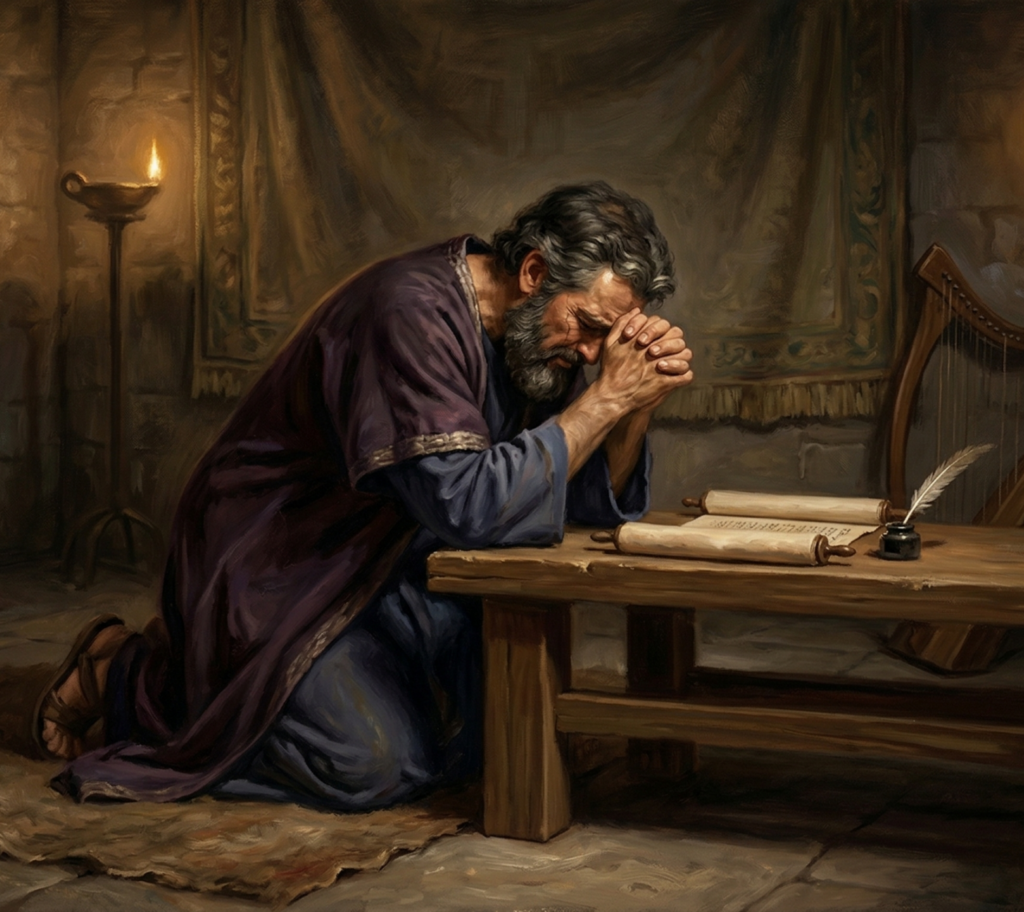
The book of Job is a poetic masterpiece that explores the justice of God, the depths of human suffering, and the undeniable frailty of man. Advocates of the depravity doctrine have leaned heavily upon verses found in Job 14 and 15 as evidence for their teaching. The text reads:
Who can bring a clean thing out of an unclean? No one! (Job 14:4)
What is man, that he could be pure? And he who is born of a woman, that he could be righteous? (Job 15:14)
Of the proof-texts used to support the doctrine of Total Hereditary Depravity, few are cited with more confidence than Ephesians 2:1-3. To the proponent of inherited sin, Paul’s description of humanity as being “by nature children of wrath” is the definitive smoking gun. It is argued that if we are under God’s wrath by nature, then that nature – and its attendant guilt – must be something we possess from the moment of conception.
B.H. Carroll, the founder of Southwestern Baptist Theological Seminary, articulated this position clearly in his Interpretation of the English Bible:
This passage knocks the bottom out of the thought that sin consists in the willful transgression of a known commandment. The apostle here refers to original sin – the nature with which we are born. 1
If Carroll is correct, then the Bible teaches that infants are born under the judicial condemnation of God. However, if we examine the context, the grammar, and the historical understanding of the Greek language, we find that Paul is not describing an inherited nature, but a spiritual condition manufactured by personal choice.
When David sat down to pen Psalm 51, he wasn’t writing a systematic theology on the origin of sin. He was a man crushed by the weight of his sin. What may have begun as a lazy season in a stalwart monarch’s life quickly deteriorated into a sin spiral. A lustful stare led to adultery with his neighbour’s wife. That moment of infidelity resulted in an impending birth. Fear of exposure drove David to deceive and intoxicate his friend Uriah, trying to cover his deed. When that failed, he sent Uriah back to the battlefield, carrying his own death sentence sealed by the king. In this Psalm, David wasn’t seeking an excuse or explanation; he was seeking a way back to God.
Calvinists love the book of Romans, believing it strongly supports their doctrine of Total Hereditary Depravity, particularly chapter 5. I suggest their reading of Romans 5 fails to grasp the true teaching of the apostle Paul (and the rest of Scripture). Advocates of the depravity doctrine often cite several verses in this chapter:
Romans 5:12, “…through one man sin entered the world, and death through sin, and thus death spread to all men, because all sinned…”
Romans 5:15, “…by the one man’s offense many died…”
Romans 5:18, “…through one man’s offense judgment came to all men, resulting in condemnation…”
Romans 5:19, “…by one man’s disobedience many were made sinners…”
Without careful study, one might conclude we died “in Adam” – that his specific sin brought spiritual death to every infant born thereafter. But there is a phrase at the end of verse 12 that serves as the master key to the entire context. Paul’s point is not that we inherited a sinful nature from Adam (as Arminius suggested) or the legal guilt of his sin (as Calvin taught). While death indeed entered the world through Adam’s transgression, the apostle explicitly stated that it spread to all men, not because of Adam’s sin, but “because all sinned.”
Jude 12, speaking of wicked men who had crept in among God’s people, reads: These are spots in your love feast, while they feast with youwithout fear, serving only themselves…
An email sent my way compared the birth, life, and death of Jesus Christ to mythological stories such as Krishna, Mithras, Attis, and others. The inference, of course, being that Jesus as we read about Him in the Bible is merely a myth. The Jesus myth.
The gift of tongues is spoken of multiple times in the New Testament. Mark 16:17 lists it among other miraculous gifts which would follow those who believe. The book of Acts says the apostles spoke with tongues (Acts 2) as well as the house of Cornelius (Acts 10) and the disciples at Ephesus (Acts 19). In writing to the Corinthian church, Paul mentioned the gift of tongues 12x in the three chapter context of 1 Corinthians 12, 13, 14. Obviously it is an important Bible topic, and unfortunately one which is often misunderstood in today’s religious world. Let’s note a few things about tongues.
For the past 14+ months, the Covid-19 pandemic has brought with it a lot of restrictions and constraints. For a good part of that time, we in Ontario have been under lockdowns, shutdowns, or stay-at-home orders. When the CDC and other drug regulatory agencies across the globe began to give the green flag for vaccines from various pharmaceutical companies, there was an understandable prospect of hope, the proverbial “light at the end of the tunnel.” At the same time, there has been skepticism and uncertainty about the safety of the vaccines, given the speed with which they were developed or the efficacy they will have on the virus variants. And then for some, there is concern that it is not just a vaccine, but could it be the mark of the beast?
Three months after leaving Egypt, the Hebrews came to Mount Sinai, where God would give His law to them. He spoke to all the people from the top of Mount Sinai, revealing His covenant with Israel. Then, He called Moses to come up Sinai, so He might give him the tablets of stone on which the law would be written (Exodus 24:12). The next several chapters reveal details of the law of Moses.
Moses would be with the Lord on the top of Sinai for 40 days. No sooner had God finished revealing & recording His law (Exodus 31:18) than trouble began in the camp. The Lord commanded Moses,
Go, get down! For your people whom you brought out of the land of Egypt have corrupted themselves. They have turned aside quickly out of the way which I commanded them. They have made themselves a molded calf, and worshiped it and sacrificed to it, and said, ‘This is your god, O Israel, that brought you out of the land of Egypt!’ (Exodus 32:7-8)
via Bundesarchiv, Bild 183-H1216-0500-002 / CC-BY-SA
Last week, while in a Bible chat room on the internet, another person in the same chat room was affirming Universalism, defined as
a theological doctrine that all human beings will eventually be saved; the principles & practices of a liberal Christian denomination founded in the 18th century originally to uphold the belief in universal salvation and now united with Unitarianism.
(Merriam-Webster.com)
According to Universalism doctrine, all people, no matter what they have done will be redeemed and go to heaven. While in the chat room, I asked the proponent of the doctrine if Adolf Hitler will also be in heaven, to which he earnestly replied “Yes.”