

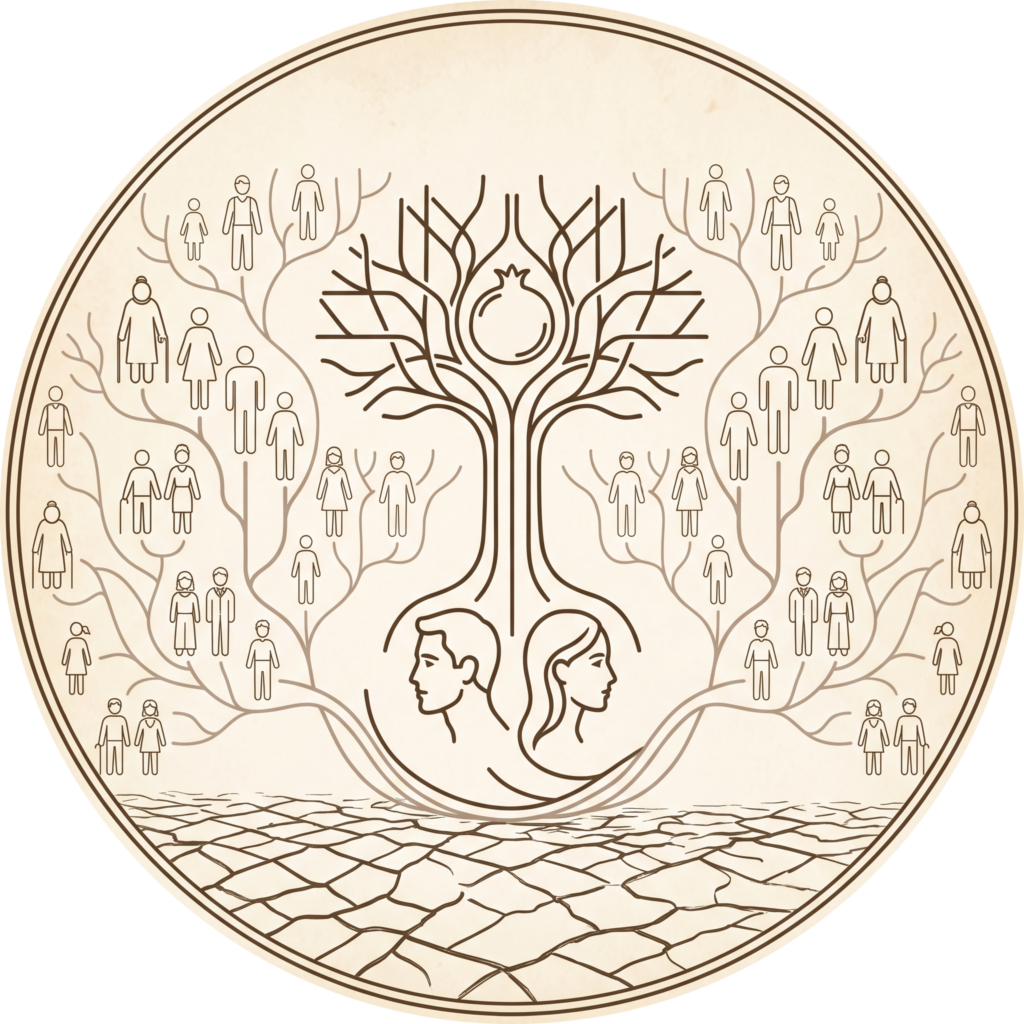
Among the Scripture fortresses constructed by advocates of the depravity doctrine, few are defended with as much zeal as the wickedness of the human heart. Those affirming our innate degeneracy condemn the human heart as corrupt from the moment of conception. To secure this premise, proponents frequently rely on a triad of Old Testament passages that appear, at first glance, to paint a bleak portrayal of human nature:
The heart is deceitful above all things, and desperately wicked; who can know it? (Jeremiah 17:9)
Then the Lord saw that the wickedness of man was great in the earth, and that every intent of the thoughts of his heart was only evil continually (Genesis 6:5)
…although the imagination of man’s heart is evil from his youth… (Genesis 8:21)
To the depravity doctrine supporter, these passages serve as definitive proof of human corruption. It is argued that because Adam sinned, every human enters the world with a heart that is deceitful from the onset, fundamentally incapable of choosing, desiring, or doing what is good before God.
However, when these texts are removed from the depravity proof-text matrix and returned to their proper context, a vastly different reality emerges. The texts do not describe a spiritual disease passed through heredity; rather, they show divine recognition of human frailty and chronicle the tragedy of rebellion acquired through repeated wicked human choices.
The Bible Heart
Before addressing the texts specifically, it is prudent to untangle a potential modern linguistic blind spot. The “heart” in contemporary Western English is almost exclusively considered the seat of emotion, romance, and subjective feeling. However, in ancient Hebrew thought, the heart (lêb) carries a much broader scope. Brown-Driver-Briggs defines lêb as the:
“inner man, mind, will, heart, understanding; inner part, midst; midst (of things); heart (of man); soul, heart (of man); mind, knowledge, thinking, reflection, memory; inclination, resolution, determination (of will); conscience; heart (of moral character); as seat of appetites; as seat of emotions and passions; as seat of courage.”
The Bible heart is the seat of emotion, but also of intellect (thinking, understanding and reflection) and the will (volition, purpose, and deliberate choice). Solomon asked the Lord to give him “an understanding heart” so he could judge the people with discernment (1 Kings 3:9). Daniel “purposed in his heart” not to defile himself with the king’s delicacies (Daniel 1:8), making a deliberate choice to not compromise his faith.
Thus, when the Lord describes the heart in the Old Testament, He is not describing an involuntary, inherited emotional defect. He is examining the seat of human intellect and volition—it is about man’s thoughts and choices. If the heart is inherently, unalterably broken from birth, human free will is destroyed, and with it, the very basis for personal moral accountability.
Jeremiah 17:9 — The Acquired Deceit of Judah’s Heart
Jeremiah 17:9 is routinely quoted as if the prophet had set out to write a timeless treatise exposing the inherently corrupt nature of every human heart. That was not his purpose at all. He was addressing the spiritual apostasy in Judah which hastened the Babylonian captivity. Using Jeremiah’s statement as a universal indictment about all human hearts is a monumental exegetical leap. Let’s put it in context.
The Sin of Judah
Specifically, the prophet is addressing the sin of Judah (Jeremiah 17:1). That doesn’t necessarily nullify an application to all human hearts, but an honest use of Jeremiah 17:9 must begin in the immediate context where it is found. What was the sin of Judah? For that, we must go back to chapter 16. The Lord told Jeremiah the people would inquire about their sin – “…what is our iniquity? Or what is our sin that we have committed against the LORD your God?” (verse 10). The response began with some background – “…your fathers have forsaken Me; they have walked after other gods…” (verse 11). That generation was not guilty of the sins of their forefathers, but this history explains the upbringing which led to their own moral callousness. The prophet continued,
“And you have done worse than your fathers, for behold, each one of you follows the dictates of his own evil heart, so that no one listens to Me.” (Jeremiah 16:12)
Centuries of idolatry among their forefathers, repeated rejection of the prophets sent to them, and deliberate ethical compromises led that generation to entrench themselves in the pursuit of wickedness. They had hardened their hearts by choosing wickedness rather than righteousness day after day. Thus, God testified against them and their sin “with a pen of iron; with the point of a diamond … on the tablet of their heart” (Jeremiah 17:1).
They Kindled God’s Wrath
The sinfulness of the people of Judah outlasted the Lord’s patience; they “…kindled a fire in My anger which shall burn forever” (Jeremiah 17:4). And yet the Lord doesn’t portray this as an innate condition which was passed from bygone generations stretching back to Adam. In fact, the Lord contrasted how they were with how they should have been:
“Cursed is the man who trusts in man and makes flesh his strength, whose heart departs from the LORD. For he shall be like a shrub in the desert… Blessed is the man who trusts in the LORD, and whose hope is the LORD. For he shall be like a tree planted by the waters…” (Jeremiah 17:5-8)
If the human heart is born naturally corrupt due to Adam’s sin, there is no departing from the Lord. If they were inherently objects of God’s wrath, the contrast is nothing more than a fairy tale. But the Lord expected them to trust in Him, not in man. However, when He searched and tested their hearts, and it came time to “give every man according to his ways” (Jeremiah 17:10), their choices (the exercise of their will) resulted in destruction.
A few verses later in the text, we find this between the prophet and his God:
“O LORD, the hope of Israel, all who forsake You shall be ashamed. ‘Those who depart from Me shall be written in the earth, because they have forsaken the LORD, the fountain of living waters.’” (Jeremiah 16:13)
The terminology does not align with the depravity doctrine at all. One who is born in sin, separated from the Lord by inheritance, cannot depart from or forsake the LORD. You cannot depart from where you have not been, nor can you forsake One whom you have never served.
The Heart is “Deceitful” and “Desperately Wicked”
The words “deceitful” and “desperately wicked” are weighty terms, but they do not require a depravity interpretation. “Deceitful” is the Hebrew ‛âqôb, which Strong identifies as “a knoll (as swelling up).” BDB says, “deceitful, sly, insidious, slippery; steep, hilly.” Nothing about the word implies it has always been so or it is an inherent design. This word and the name Jacob share the same root word – ‛âqab, which means “to supplant, circumvent … assail insidiously, overreach” (Strong’s), inferring a change of condition.
The Hebrew ‘ânash is translated a few different ways. The NKJV reads “desperately wicked,” ESV and NASB say “desperately sick,” while some other translations are more explicit – “beyond cure” (NIV) and “incurable” (ISV, YLT). Strong defines it as, “to be frail, feeble, or melancholy: – desperate (-ly wicked), incurable, sick, woeful.” But was this an acquired state or an inborn nature? In Jeremiah chapters 1-16, the prophet outlined Judah’s long history of ignoring warnings, adopting idols, and hardening their own hearts. By the time you reach Jeremiah 17:9, the heart isn’t merely sick; it has reached a terminal stage. Jeremiah was not saying the heart is fundamentally wicked by nature; he is saying the heart of the people of Judah had become so deeply entrenched in rebellion and sin that they had reached an “incurable” climax. Of the same period in history, the writer of Chronicles stated:
“And the LORD God of their fathers sent warnings to them by His messengers, rising up early and sending them, because He had compassion on His people and on His dwelling place. But they mocked the messengers of God, despised His words, and scoffed at His prophets, until the wrath of the LORD arose against His people, till there was no remedy.” (2 Chronicles 36:15-16)
If they were inherently corrupt and beyond cure from birth, why would the Lord send warnings through messengers and prophets? They became corrupt. They became incurable. Thus, things degenerated to the point where God’s wrath was kindled and “there was no remedy.”
The Greater Context of Jeremiah
Jeremiah 17:9 is not on an island by itself. We cannot divorce this verse from the flow of the book. While there is a lot of judgment language and acknowledgment of the wickedness of that generation, there are statements about past faithfulness and encouragement to return to God. Jeremiah 2:2-3 speaks of a time when the people pursued God, when they were holy. But then as a nation they had “gone far from Me, have followed idols, and have become idolaters” (verse 5). They were not corrupt from birth, but as a people had turned away from the Lord to idolatry.
In Jeremiah 6, the prophet appealed to the historical precedent of their ancestors, urging his contemporaries to look back on such as the foundation by which they should live. We read:
“Thus says the LORD: ‘Stand in the ways and see, and ask for the old paths, where the good way is, and walk in it; then you will find rest for your souls. But they said, ‘We will not walk in it.’” (Jeremiah 6:16)
Why would the Lord urge those who are born sinful and slated for destruction to “ask for the old paths” and to “walk in it”? If they are inherently corrupt, they could not do so. It would be nothing more than a cruel taunt. The Lord bid them to see and ask and walk in the good way because it was within their ability to choose to do so. Their response was not “We cannot,” but “We will not.”
Shortly after our text, in Jeremiah 22, the prophet points to a very recent period of corporate and royal faithfulness – the reign of king Josiah, who had led major religious reforms in Judah. In a sharp rebuke to Josiah’s wicked son, Jehoiakim, Jeremiah wrote:
“‘Shall you reign because you enclose yourself in cedar? Did not your father eat and drink, and do justice and righteousness? Then it was well with him. He judged the cause of the poor and needy; then it was well. Was not this knowing Me?’ says the LORD. ‘Yet your eyes and your heart are for nothing but your covetousness, for shedding innocent blood, and practicing oppression and violence.’” (Jeremiah 22:15-17)
Jeremiah used Josiah’s reign – well within the memory of his contemporary audience – as proof that living faithfully and upholding justice was entirely possible and brought God’s favour. Jehoiakim, like the rest of the nation, had turned his heart away from God.
Genesis 6:5 — The Path to Pre-Flood Corruption
Long before Jeremiah, the antediluvian world reached such a terrifying peak of moral degradation that God determined to destroy all humanity. Moses records this dark age in Genesis 6:5:
“Then the Lord saw that the wickedness of man was great in the earth, and that every intent of the thoughts of his heart was only evil continually.”
Advocate of the depravity doctrine read this and nod their heads in agreement. The text says what they have been telling us all along – man’s very thoughts are only evil continually. If this is not a description of an inherited depraved human nature, what else could it be?
However, a chronological reading of the Genesis narrative demonstrates that this awful state of affairs was achieved through a historical progression of wickedness, not inherited at birth.
The Uprightness of Mankind
Genesis 6 pictures the end result of generations of decline in the human story. After God made man and woman, the Lord looked upon His creation and pronounced it “very good” (Genesis 1:31). When sin entered the world through Adam and Eve, it did not result in every offspring thereafter being innate moral degenerates. The Genesis narrative tells about Cain and Abel, the first two sons mentioned in the post-fall world. Surely, if the Spirit of God wanted to make it clear that all humanity is inherently corrupt because of Adam’s sin, it would make sense to demonstrate such with their offspring. And yet we find that Abel was righteous (Genesis 4:4; cf. Hebrews 11:4). And though Cain was an angry and jealous man (Genesis 4:5), God did not tell him he was a helpless victim of an inherited depraved nature. Instead, God offered a clear, moral choice:
“If you do well, will you not be accepted? And if you do not do well, sin lies at the door. And its desire is for you, but you should rule over it.” (Genesis 4:7)
If hereditary depravity were true, God’s command to Cain to “master” sin would be nothing more than mockery. If a parent commanded a child to complete a task far beyond their capability and then punished them for failing, we would deem such to be deeply unjust. Yet, framing God’s command to Cain as an impossible task pains a similar portrait of divine justice. God is righteous, blameless and just. Cain had the ability and the moral capacity to rule over temptation. He simply chose not to.
Yet, John Calvin, whose name has become synonymous with the depravity doctrine (Calvinism), has said of man’s relationship to sin:
“We are all sinners by nature, therefore we are held under the yoke of sin. But if the whole man is subject to the dominion of sin, surely the will, which is its principle seat, must be bound with the closest chains.”
Calvin would tell Cain you cannot choose to do what is right. Sin has such mastery and dominion over you (and all humans) such that the will to choose good is beyond your capacity. John Calvin’s position is the exact opposite of what God said.
“All Flesh Had Corrupted Their Way”
Between God’s call for Cain to rightly exercise his freedom to choose what is right in Genesis 4 and the divine judgment of Noah’s day in Genesis 6, more than a millennium of human history passed. During this vast stretch of time, humanity multiplied, and with that multiplication came a compounding of unchecked violence, rebellion, and cultural degradation. This is not because man could not do what was right – but increasingly more over time, they chose to do what was wrong. It is easier to go with the flow, to float down the river of sin, than to stand for righteousness and justice.
Moses provides this explicit, inspired commentary on how the earth arrived at the abominable state described in Genesis 6:5. He explained,
“So God looked upon the earth, and indeed it was corrupt; for all flesh had corrupted their way on the earth.” (Genesis 6:12)
The text does not say, “Adam had corrupted all flesh’; it says “all flesh had corrupted their way.” The Hebrew verb used for “corrupt” (shâchath) is defined by BDB as, “to destroy, corrupt, go to ruin, decay; to be marred, be spoiled, be corrupted…” All of these words describe a process, a movement from a state of good towards destruction. Humanity actively ruined itself through successive, compounding generations of open, unbridled rebellion.
Furthermore, if this state were the natural, unavoidable, and immediate result of Adam’s fall, God’s emotional reaction is hard to understand.
“And the Lord was sorry that He had made man on the earth, and He was grieved in His heart” (Genesis 6:6).
Why did it take God over 1,000 years to come to the realization that He was sorry He made man? If all humanity had been inherently corrupt and unable to do any good before the Lord from Adam onward, then what changed in Noah’s time? Moses tells us God was grieved because humans, whom He created to have fellowship with their Maker, chose en masse to walk the path of self-destruction rather than righteousness.
Genesis 8:21 — Understanding “From His Youth”
Following the judgment of the flood, Noah built an altar and offered sacrifices to the Lord. God smelled the soothing aroma and made a covenantal declaration:
“…I will never again curse the ground for man’s sake, although the imagination of man’s heart is evil from his youth; nor will I again destroy every living thing as I have done.” (Genesis 8:21)
The phrase, “evil from the days of his youth,” is the sort of statement the depravity doctrine advocates look for in Scripture. Of course, as they discuss the text and meld it into their doctrine, there is an inevitable subtle shift in language, and soon they are not talking about evil done in the days of someone’s youth, but rather “from birth” or “from conception.”
Youth vs The Womb
The Hebrew word for “youth” is nâ‛ûr, which consistently refers to an adolescent or young man. Strong’s says, “youth, the state (juvenility) or the persons (young people): – childhood, youth.” The Scriptures call a seventeen year-old Joseph a youth (Genesis 37:2). David, when he went to fight against Goliath was a youth (1 Samuel 17:33). If God had meant to say “infancy,” “birth,” or “from the womb” in Genesis 8:21, the Hebrew language is perfectly adequate to express such a thought. But the Lord used nâ‛ûr not mibeṭen, reḥem, or yālad. The Holy Spirit had Moses explicitly and intentionally used a term for youth, not infancy. His statement is not that man’s heart is evil from the womb but that the heart of the youth is prone to be led away by evil.
The Logic of Divine Forbearance
There is a logical structure to God’s statement in Genesis 8:21. He used man’s propensity to pursue sin “from his youth,” not as a reason to execute swift and immediate destruction, but as a reason for patience and mercy. If humans were born inherently guilty and totally depraved due to Adam’s sin, God’s reasoning here would make no sense. Why would a holy God look at unchangeable, innately flawed people who will be condemned and destroyed in hell and promise not to destroy them?
God recognized their frailty. He acknowledged that even the post-flood world would be marred by the consequences of sin – that as innocent children grow into their youth, they would encounter temptation and inevitably fail and stumble. Rather than bring another flood or find other ways to destroy humanity, God promised to maintain the natural order of the earth (Genesis 8:22), allowing time for patience, repentance, and ultimately, redemption.
Conclusion
When Jeremiah 17:9, Genesis 6:5, and Genesis 8:21 are isolated from their contexts, these texts can be easily manipulated to support the depravity doctrine. However, when we allow the texts to speak in their proper historical and grammatical setting, we find the harmony of God’s message:
Mankind is created upright, possessing the volitional capacity to choose good or evil, to master temptation or surrender to it.
The heart becomes “desperately wicked” and “deceitful” through practice, not birth. It is an acquired condition resulting from repeated choices to engrave sin upon the soul.
As children grow into their “youth,” they inevitably stumble under the weight of temptation and human frailty. This reality marks our desperate need for a Savior, but it places the blame squarely on the shoulders of the individual transgressor, not our forefather Adam.
Humanity’s problem is not that we are born with a corrupt heart that cannot choose God; the problem is that we have willfully chosen to follow the deceitful crooked paths of our own making. The remedy is not some forced regeneration that bypasses human volition, but a conscious, free-will decision to hear the gospel, repent of our rebellion against God, and submit ourselves to obeying God’s will so our hearts can be cleansed and made new.
Sources Cited
Lexicons & Reference Tools
- Brown, Francis, S. R. Driver, and Charles A. Briggs. A Hebrew and English Lexicon of the Old Testament (BDB). Oxford: Clarendon Press, 1906.
- Strong, James. Strong’s Exhaustive Concordance of the Bible. Nashville: Abingdon Press, 1890.
Historical & Theological Works
- Calvin, John. Institutes of the Christian Religion. 1559. Translated by Henry Beveridge. Edinburgh: The Calvin Translation Society, 1845. (Book 2, Chapter 2, Section 27).
Bible Translations Referenced
- Young’s Literal Translation (YLT)
- English Standard Version (ESV)
- International Standard Version (ISV)
- New American Standard Bible (NASB)
- New International Version (NIV)
- New King James Version (NKJV)
Links: YouVersion | GROW magazine
Return to the article archive